
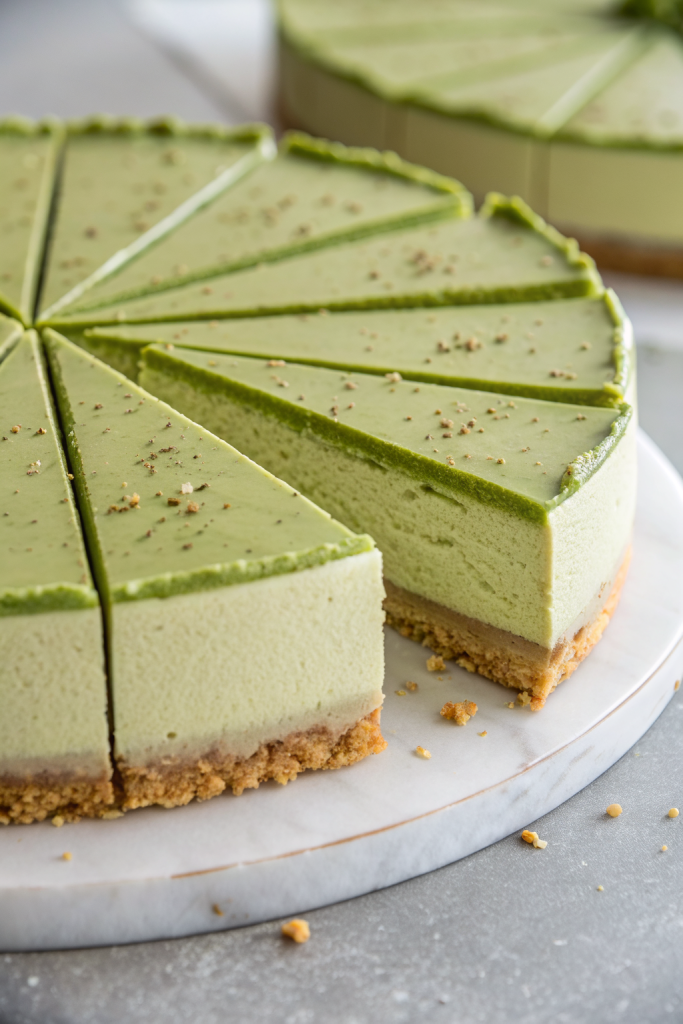
Original Matcha Japanese Cheesecake Recipe tastes like a cloud of creamy cheesecake with gentle green tea bitterness and just enough sweetness to keep you going back for “one more” slice. It suits matcha lovers, cheesecake fans, and anyone who wants a showstopper dessert in about 2 hours total (mostly hands-off). I tested this recipe so many times that my neighbors started “checking in” at suspiciously perfect cheesecake o’clock.
Why Original Matcha Japanese Cheesecake Recipe Is Worth It
This Japanese cotton cheesecake version bakes up incredibly light, with a souffle-style wobble and a melt-in-your-mouth texture. The matcha adds earthy depth, balances the richness, and gives the cake a gorgeous natural green color that looks fancy without much effort.
You only need basic ingredients plus good matcha powder and a springform pan. The recipe uses a gentle baking method and a water bath, so the cheesecake rises tall, stays moist, and avoids big cracks.
“This Original Matcha Japanese Cheesecake Recipe tastes like a fluffy matcha cloud and disappears from the plate faster than any dessert I serve. ★★★★★”
Ingredients You Need
Key Ingredients
-
Cream cheese – 8 oz (225 g), full-fat, block style, at room temperature.
- Skip whipped tubs since they add too much air and extra stabilizers.
- I like Philadelphia or a store brand that lists simple ingredients.
-
Unsalted butter – 3 tbsp (40 g), melted and slightly cooled.
- Salted butter works in a pinch; just reduce added salt a bit.
-
Whole milk – ½ cup (120 ml), at room temperature.
- Use 2% if needed, but whole milk gives better richness.
-
Eggs – 4 large, at room temperature, separated.
- Cold eggs whip poorly and cause a dense cake, so let them sit out.
- If you forget, place them (in shells) in warm water for 5–7 minutes.
-
Granulated sugar – ½ cup + 2 tbsp (125 g), divided.
- Use superfine sugar if you have it; it dissolves faster in egg whites.
- Avoid brown sugar here since it muddies the color and flavor.
-
Cake flour – ½ cup (60 g), sifted.
- If you only have all-purpose flour, measure ½ cup, remove 1 tbsp, and add 1 tbsp cornstarch, then sift well.
- Cake flour keeps the crumb tender and light.
-
Cornstarch – 2 tbsp (15 g), sifted.
- This helps the cheesecake hold structure without heaviness.
-
Matcha powder – 2–3 tsp, culinary or ceremonial grade.
- Use a bright green, fresh-smelling matcha; dull brownish powder tastes bitter and flat.
- I often use brands like Ippodo or MatchaBar, but any high-quality Japanese matcha works.
-
Vanilla extract – 1 tsp.
- Adds roundness and softens the grassy notes of matcha.
-
Fine sea salt – ¼ tsp.
- Balances sweetness and sharpens the matcha flavor.
-
Lemon juice – ½ tsp, for the egg whites.
- You can swap with ½ tsp cream of tartar; this stabilizes the meringue.
Optional Toppings
- Light dusting of matcha powder (through a fine sieve)
- Whipped cream (unsweetened or lightly sweetened)
- Fresh berries (strawberries, raspberries, blueberries)
- Thin drizzle of honey or simple syrup if you like extra sweetness
Pantry Shortcuts & Notes
- Use pre-sifted cake flour if you want to skip extra sifting steps.
- Use boxed egg whites only if the label says “for whipping”; otherwise they often whip poorly.
- If you own a matcha whisk (chasen), use it to break up clumps in the matcha with a little milk before adding to the batter.
Equipment List
- 8-inch (20 cm) round springform pan or loose-bottom cake pan
- Larger round pan or roasting pan for the water bath
- Electric hand mixer or stand mixer with whisk attachment
- Two medium mixing bowls and one large mixing bowl
- Fine mesh sieve for flour and matcha
- Rubber spatula
- Parchment paper
- Aluminum foil
- Kitchen scale (optional but very helpful for accuracy)
- Toothpick or thin skewer to test doneness
Quick Tips & substitutions
- Line the bottom and sides of the pan with parchment to prevent sticking and help the cake rise evenly.
- Wrap the outside of the pan tightly with foil so water from the bath does not seep into the cheesecake.
- Use room-temperature cream cheese, milk, and egg yolks so the batter mixes smoothly without lumps.
- Sift the matcha with flour and cornstarch to avoid green clumps in the batter.
- Whip egg whites to soft, glossy peaks, not stiff, so the cake rises evenly and does not crack as much.
- Add sugar to the egg whites gradually to build a stable meringue.
- Fold the meringue into the batter gently with a spatula, using a “scoop and turn” motion to keep the batter airy.
- Reduce matcha to 2 tsp if you prefer a milder flavor, or increase to 3 tsp for a more intense matcha punch.
- Swap whole milk with unsweetened soy milk or oat milk if you need a dairy-light option, but keep cream cheese dairy for best texture.
- Bake low and slow (around 300°F / 150°C) with a water bath to keep the cheesecake moist and prevent a rubbery texture.
- Do not open the oven door during the first 45 minutes or the cake can deflate.
- Cool the cheesecake gradually in the oven with the door cracked to reduce shrinking and wrinkling.
- Chill at least 4 hours, ideally overnight, before slicing for clean cuts and best flavor.
- Run a thin knife around the edge while still slightly warm to prevent the top from tearing as it cools.
- Use a hot, wiped knife for each slice to keep the layers neat and pretty.
How to Make Original Matcha Japanese Cheesecake Recipe
Step 1: Prep the pan and oven
Preheat your oven to 300°F (150°C). Line the bottom of an 8-inch springform pan with parchment and line the sides with a tall strip of parchment that rises about 1–1.5 inches above the rim. Wrap the outside of the pan with 2–3 layers of heavy-duty foil to keep the water bath out.
Place a large roasting pan on the middle rack of the oven. Start a kettle or pot of water to boil so you have hot water ready for the bath. Keep everything ready so you can move quickly once you fill the cheesecake pan.
Step 2: Mix the cream cheese base
In a large bowl, beat the room-temperature cream cheese with an electric mixer until very smooth and creamy, about 2 minutes. Add the melted butter and mix until fully combined and glossy. Pour in the milk and mix again until the mixture looks silky and lump-free.
Add the egg yolks, vanilla, and salt to the bowl. Beat until the mixture turns pale and smooth. Scrape down the sides of the bowl so no thick cream cheese hides at the bottom.
Step 3: Add matcha and dry ingredients
In a separate bowl, sift together cake flour, cornstarch, and matcha powder. Sift at least once, and twice if your matcha tends to clump. The mixture should look evenly green with no dark specks.
Add the dry ingredients to the cream cheese mixture in two additions. Use a whisk or spatula and mix gently until no streaks of flour remain. Do not overmix, since that can toughen the texture.
Step 4: Whip the meringue
Place the egg whites in a clean, dry bowl. Add the lemon juice or cream of tartar. Beat on medium speed until the egg whites look foamy and light.
Start adding the sugar (½ cup / 100 g) gradually, 1–2 tablespoons at a time, while you continue to beat. Increase the speed to medium-high and beat until the meringue forms soft, glossy peaks that curl over when you lift the beaters. Stop before the peaks turn stiff and chunky, since that makes folding harder and can cause a dense cake.
Step 5: Fold the meringue into the matcha batter
Add about one-third of the meringue to the matcha batter. Use a spatula and fold gently to lighten the mixture, scraping the bottom and sides of the bowl. Do not worry about a few streaks at this stage.
Add the next third of the meringue and fold more carefully, using a scoop-and-turn motion. Add the final third and fold until the batter looks even in color with no visible white streaks. Keep as much air as possible in the batter so the cheesecake bakes tall and fluffy.
Step 6: Fill the pan and set up the water bath
Pour the batter into the prepared springform pan. Tap the pan gently on the counter 2–3 times to pop large air bubbles. Use a skewer or chopstick to swirl through the batter in a zigzag pattern to release hidden bubbles.
Place the foil-wrapped pan into the preheated roasting pan in the oven. Carefully pour hot water into the roasting pan until it reaches about halfway up the sides of the cheesecake pan. Close the oven door gently so the water does not splash into the batter.
Step 7: Bake the cheesecake
Bake at 300°F (150°C) for about 60–70 minutes, until the top looks set, lightly golden around the edges, and still slightly jiggly in the center. If the top browns too quickly, tent it loosely with a piece of foil. Test doneness by inserting a skewer near the center; it should come out mostly clean with a few moist crumbs, not wet batter.
Turn off the oven and crack the door open slightly with a wooden spoon. Leave the cheesecake inside for 15–20 minutes so it cools gradually. This slow cool helps prevent dramatic shrinking and big cracks.
Step 8: Cool completely and chill
Remove the cheesecake from the water bath and place it on a wire rack. Run a thin knife around the edge to loosen it from the parchment and sides of the pan. Let it cool to room temperature, about 1–1.5 hours.
Once cool, cover the pan and chill the cheesecake in the fridge for at least 4 hours, or overnight. When ready to serve, release the springform ring and peel away the parchment. Slice with a hot, clean knife and wipe between cuts for neat slices.
Recipe Variations
- Gluten-free option – Use a gluten-free cake flour blend or swap cake flour with a mix of ¼ cup rice flour + ¼ cup cornstarch; sift very well.
- Lower sugar – Reduce sugar in the meringue by 1–2 tbsp; keep some sugar so the meringue stays stable.
- Extra matcha intensity – Increase matcha to 3–3½ tsp and add an extra 1 tbsp sugar to balance the bitterness.
- Citrus twist – Add 1 tsp finely grated lemon or yuzu zest to the cream cheese base for a bright note.
- Chocolate swirl – Drizzle 2–3 tbsp melted white chocolate over the batter and swirl gently with a skewer before baking.
- Vegan-inspired flavor (not fully vegan) – Use plant milk and a dairy-free cream cheese for a lighter dairy load, but keep in mind that egg whites still provide the signature fluffy texture.
- Mini cheesecakes – Bake in lined muffin tins (no water bath) at 300°F (150°C) for 20–25 minutes; check early since they bake faster.
Ways to Serve Original Matcha Japanese Cheesecake Recipe
- Serve chilled with a light dusting of matcha and a spoonful of whipped cream.
- Add fresh berries on the side to cut through the richness and add color.
- Pair with hot green tea, hojicha, or a simple latte for a cozy dessert moment.
- Cut into small squares and serve on a dessert platter for parties or afternoon tea.
- Top with a drizzle of honey or simple syrup if you like a sweeter finish.
Storage Success
Store leftover matcha Japanese cheesecake covered in the fridge for up to 4 days. Keep it in an airtight container or wrap the pan tightly so it does not absorb fridge odors. Slice only what you plan to serve so the rest stays moist and fresh. If you want to keep it longer, freeze individual slices wrapped in plastic and then in a freezer bag for up to 1 month, and thaw them in the fridge before serving.